Grim reaper tattoos
A grim reaper tattoo shows death as a hooded skeleton with a scythe, an image that took shape in late medieval Europe after the Black Death. Today it is worn as much for courage and survival as for darkness.
55 designs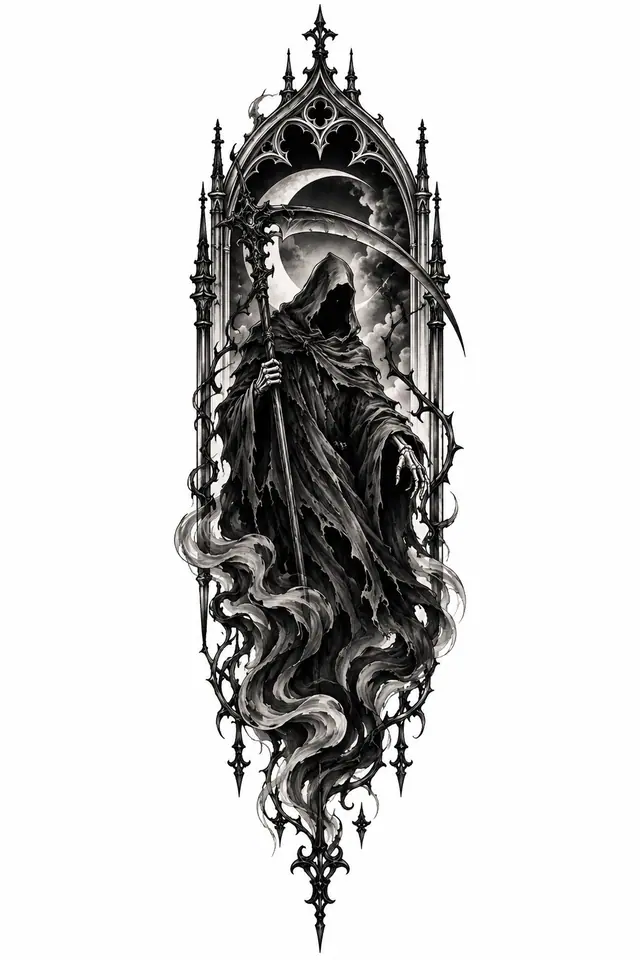
What a grim reaper tattoo shows
The grim reaper is death given a body: a skeleton or shrouded figure, nearly always hooded, nearly always holding a scythe. As a tattoo it ranges from a full figure standing in a graveyard to a single bony hand closed around a scythe handle.
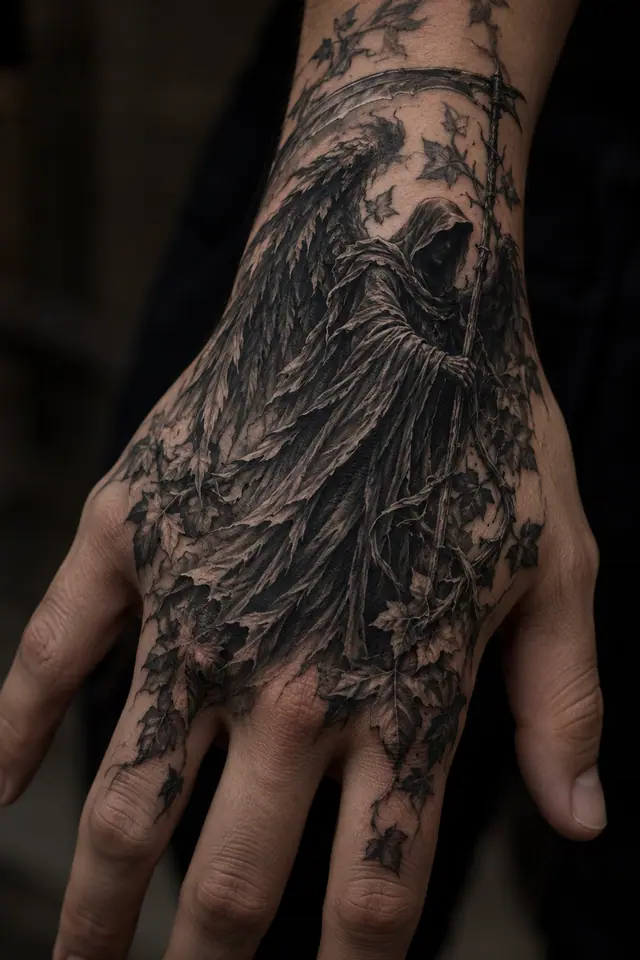
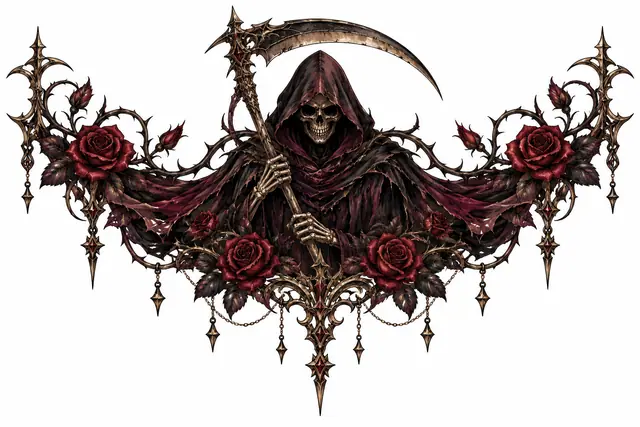
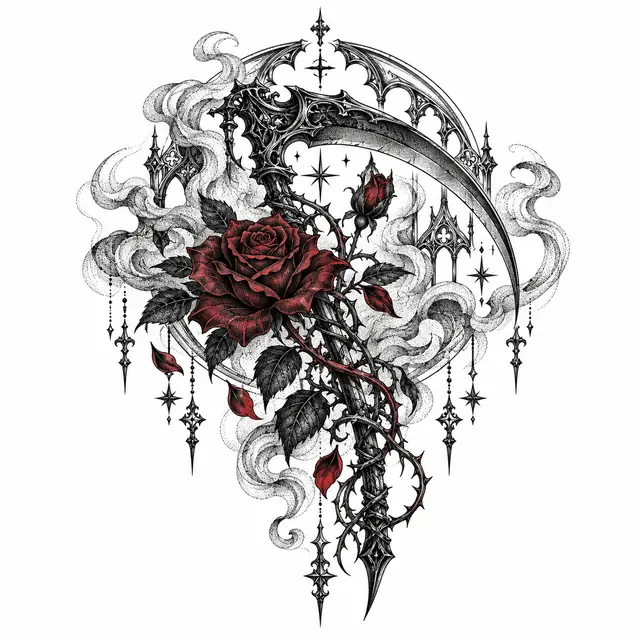
Our gallery covers the main forms. There is the classic hooded reaper with a scythe, a reaper holding an hourglass, a skeletal hand gripping the scythe, a reaper in flowing robes with ragged wings, a reaper standing among gravestones under a moon, a hooded reaper whose robe turns into smoke, and the most minimal version, a scythe crossed with a rose.
What makes or breaks a reaper is the face, or the absence of one. The strongest designs often keep the hood as a deep black opening with only a hint of skull inside. A solid black void reads from across a room and holds its shape for decades. A fully rendered skull face inside the hood is possible, but it needs space for shading around the eye sockets and teeth.
Where the image comes from
Death as a walking skeleton is a late medieval European invention. After the Black Death swept across Europe between 1347 and 1351 and killed a huge share of the population, art about dying became more common and far more graphic. Sculptors carved “transi” tombs that showed the dead as decaying corpses beneath effigies of the same person in fine clothes.
The Danse Macabre, or Dance of Death, became one of the most copied images of the period. Painted cycles showed skeletal figures leading popes, kings, merchants and laborers toward the grave in one line, since death made no distinction between them. A famous version was painted on the walls of the Holy Innocents’ Cemetery in Paris in the 1420s. The mural is long gone, but printed copies survive. Hans Holbein the Younger’s Dance of Death woodcuts, published in 1538, carried the theme across Europe.
Early figures of death carried all kinds of weapons, including arrows, spears and coffins. The scythe won out for two reasons. It fits the old metaphor of people being cut down like grain at harvest, and it was already the tool of Father Time in Renaissance art, who also carried an hourglass. The two figures borrowed each other’s props, which is why an hourglass looks so natural in a reaper’s hand.
The flowing black robe and deep hood are a later development, closer to the image most people picture now. The name is also younger than many expect: “Grim Reaper” shows up in English print in the 19th century. Before that, English speakers simply called the figure Death.
What it means today
The medieval message was blunt: no one escapes. Modern readings are more personal, and they vary:
- Acceptance of mortality, close to the idea behind memento mori tattoos.
- Survival. People who came through a serious illness, an accident, an overdose or combat sometimes wear the reaper as the thing they walked past.
- Memorial. A reaper with a name, a date or a single rose can mark a loss without a portrait.
- Fearlessness, death treated as a companion rather than a threat.
One practical note: some motorcycle clubs and military units use reaper imagery in their insignia. A reaper combined with a specific patch layout, unit number or club lettering can be read as a claim of membership. A plain reaper carries no such meaning.
Popular designs and combinations
The hooded reaper with a scythe is the classic. The scythe gives you a long diagonal line that fits a forearm, calf or the side of the torso, with the figure tucked below it.
The reaper holding an hourglass shifts the focus from death to time. It pairs well with a raven perched on the hourglass or the reaper’s shoulder.
A skeletal hand gripping a scythe is the compact version. Finger bones wrap a forearm or the back of a hand nicely, and a skull at the base of the handle makes it read instantly as gothic.
The winged reaper in ragged robes needs width. Wings spread across the upper back or chest turn it into a symmetrical centerpiece.
The graveyard scene, with headstones and a moon behind the figure, is a full narrative piece that suits a thigh, back or half sleeve.
The smoke robe fades from a solid hood into wisps that disappear into bare skin. It is one of the best options for connecting a reaper into a sleeve, because the smoke can flow into neighboring pieces.
A scythe crossed with a rose drops the figure entirely. It is subtle enough for people who want the meaning without a skeleton on display.
Styles that suit it
Black and grey is the natural home for reapers. Cloth folds, smoke and the gloom inside the hood all depend on smooth grey gradients. Our black and grey designs show how much depth soft shading can give a robe.
Etching nods directly to the woodcuts and engravings that spread the Dance of Death. Crosshatched shading gives a reaper the look of an old print, and it ages well because the hatching is built from lines rather than fragile soft tones.
Blackwork treats the robe as a solid mass with the highlights left as bare skin. It is bold and long-lasting, and a large black robe is also a strong tool for covering an old tattoo.
Red accent works when the red is limited to one thing: a rose, a drop of blood or an ember of light in the hood.
Neo-traditional gives the reaper bold outlines with burgundy, plum and antique gold in the robe trim and scythe handle.
Fine-line suits the scythe-and-rose or a small hand, but a full fine-line reaper tends to look thin and weak once it heals.
Placement and size
| Version | Practical minimum | Good placements |
|---|---|---|
| Scythe crossed with a rose | about 3 inches long | inner forearm, side of calf, ankle |
| Skeletal hand on a scythe | 3 to 4 inches | forearm, back of hand, shoulder |
| Hooded reaper bust | about 4 inches tall | upper arm, shoulder, calf |
| Full standing reaper | 6 to 8 inches tall | forearm, calf, outer thigh |
| Winged reaper or graveyard scene | 10 inches and up | back, thigh, half sleeve |
The scythe blade is the detail most likely to fail. Its cutting edge is a long, thin crescent, and if the line is too fine it spreads into a soft gray smear over the years. Ask for a slightly heavier edge line than looks necessary on paper. With finger bones, leave visible skin between each digit so the hand doesn’t merge into a single shape. For more on fitting tall and wide designs to the body, see our gothic tattoo placement guide.
Things to watch out for
A reaper is mostly dark mass, so plan the light. Decide where the light source sits, usually above and to one side, and keep the bright edges consistent across hood, hands and blade. Without that, the figure turns into a flat silhouette.
If you want a reaper to hide old ink, it is a good choice, since a hood and robe can absorb a lot of previous work. Our guide to gothic cover-up tattoos covers what a cover-up can and can’t hide.
Using the prompts
Every design in the gallery is an AI concept made in ChatGPT, so treat it as a starting point and have your tattoo artist redraw it to fit your body. Open any reaper design to copy its prompt, then swap the hourglass for a lantern, change the style to etching, or move the figure under a different moon.
Grim reaper tattoo designs
Questions people ask
What does a grim reaper tattoo mean?
Historically the reaper stood for the fact that death takes everyone, rich or poor. Today people commonly wear it as acceptance of mortality, as a mark of having survived something that nearly killed them, or in memory of someone who died.
Where does the grim reaper come from?
Death as a walking skeleton spread through European art after the Black Death of 1347 to 1351, especially in Dance of Death murals and prints. The scythe and hourglass were partly borrowed from Father Time, and the English name Grim Reaper only appears in print in the 19th century.
What does a grim reaper holding an hourglass mean?
The hourglass shows that each life has a measured amount of time. A reaper holding one is usually read as a reminder that the sand is running for everyone, so time should be used well.
Is a grim reaper tattoo bad luck?
There is no established tattoo tradition that treats the reaper as unlucky. Some people find the image unsettling, but many wearers see it as making peace with death rather than inviting it.
How big should a grim reaper tattoo be?
A full standing reaper needs roughly 6 to 8 inches of height to keep the hands, scythe and folds of the robe distinct. Smaller pieces work better as a single element, such as a skeletal hand on a scythe or a scythe crossed with a rose.
Related motifs
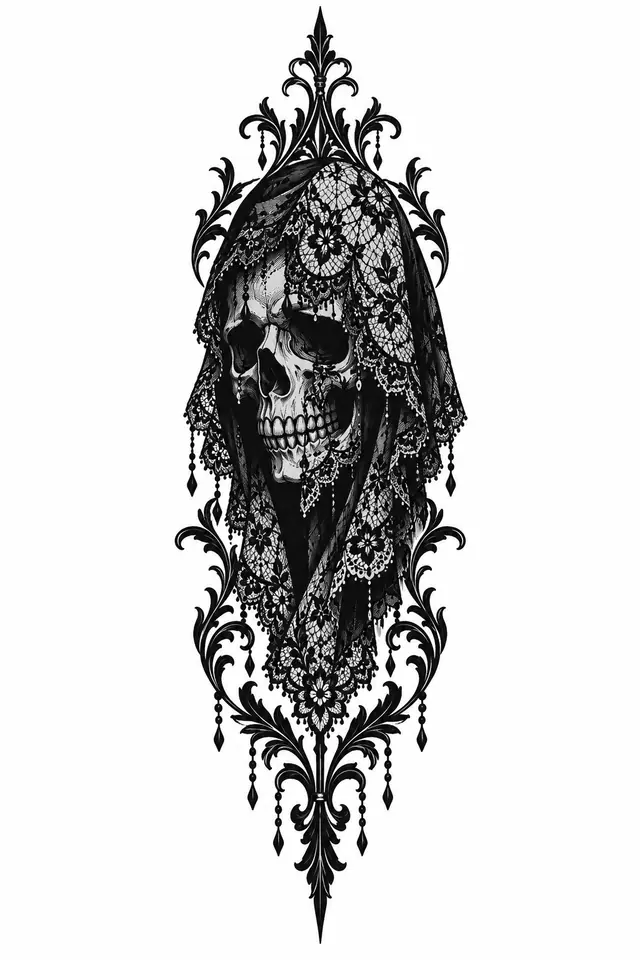 SkullMortality worn openly: the oldest reminder that life is short.
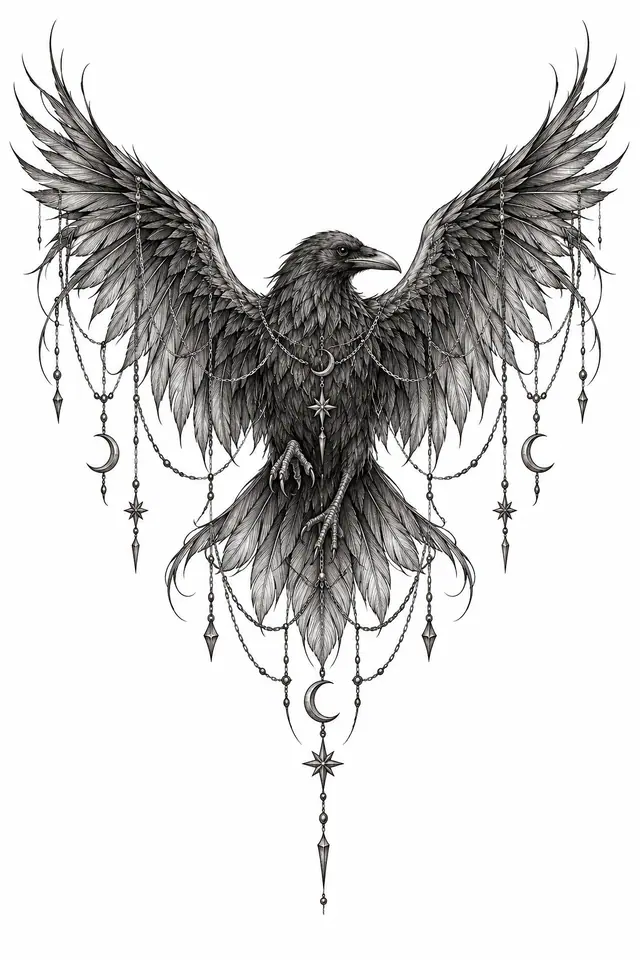 Raven and crowPoe's messenger, read as omen, memory and intelligence.
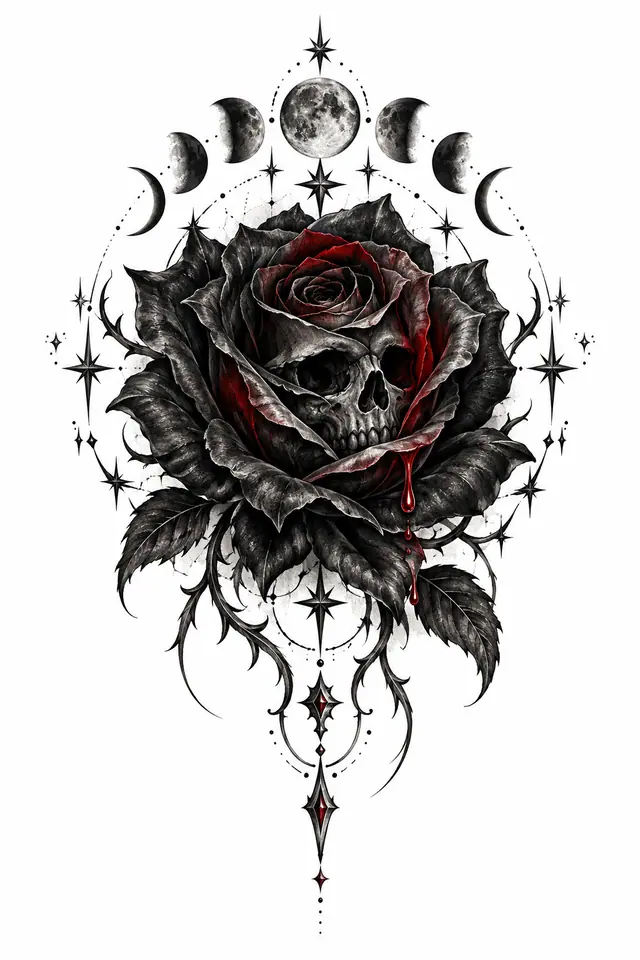 Black roseLove that outlives loss, grief and farewells.
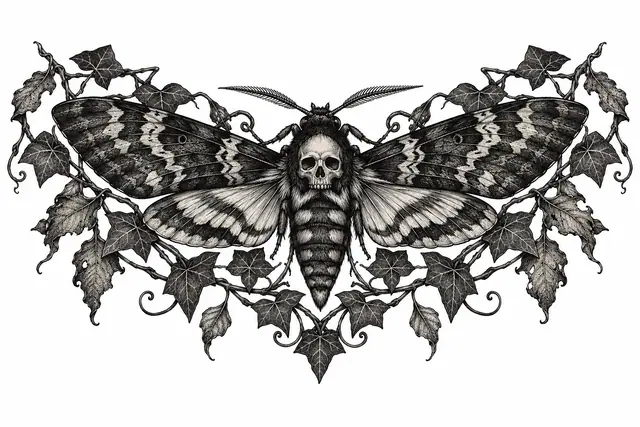 MothDrawn to the flame: transformation, night and the soul.
 BatCreature of the night, linked with rebirth and Dracula.
 Gothic crossFaith in stone and thorns, from churchyards to chains.
 CathedralPointed arches and rose windows from 12th-century France.
 GargoyleStone guardians that kept rain and evil off the roof.
 VampireRomance and hunger, from Victorian novels to now.