Gothic lace tattoos
A gothic lace tattoo uses the patterns of Victorian lace, filigree jewelry and crystal chandeliers as ornament on the skin. It carries less fixed symbolism than other motifs and much more technical risk, so design matters.
55 designs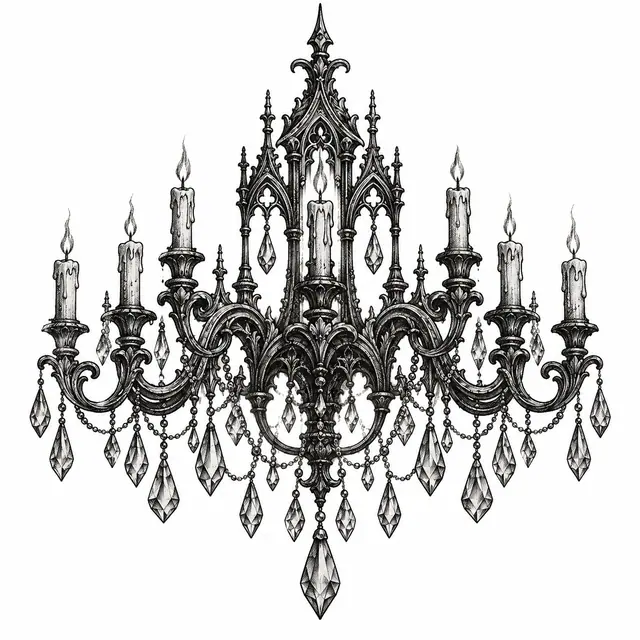
What a gothic lace tattoo is
Lace tattoos imitate textile: scalloped edges, floral medallions, mesh and openwork. In gothic tattooing the category stretches to include filigree, the jeweler’s technique of fine curled metal wire, and chandeliers, with their arms and hanging crystal drops. All three share a look of ornate, airy pattern built around open space.
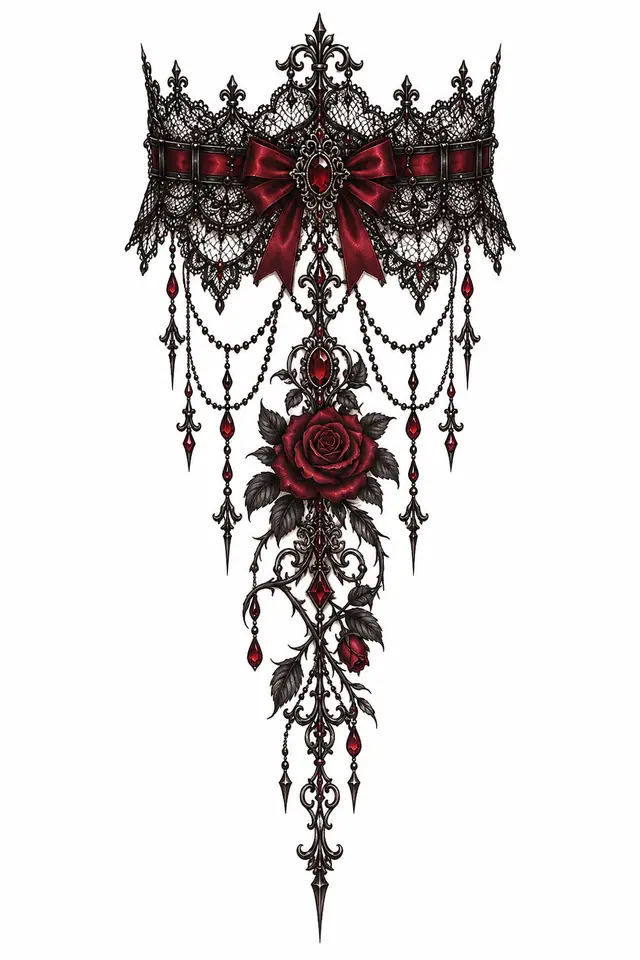
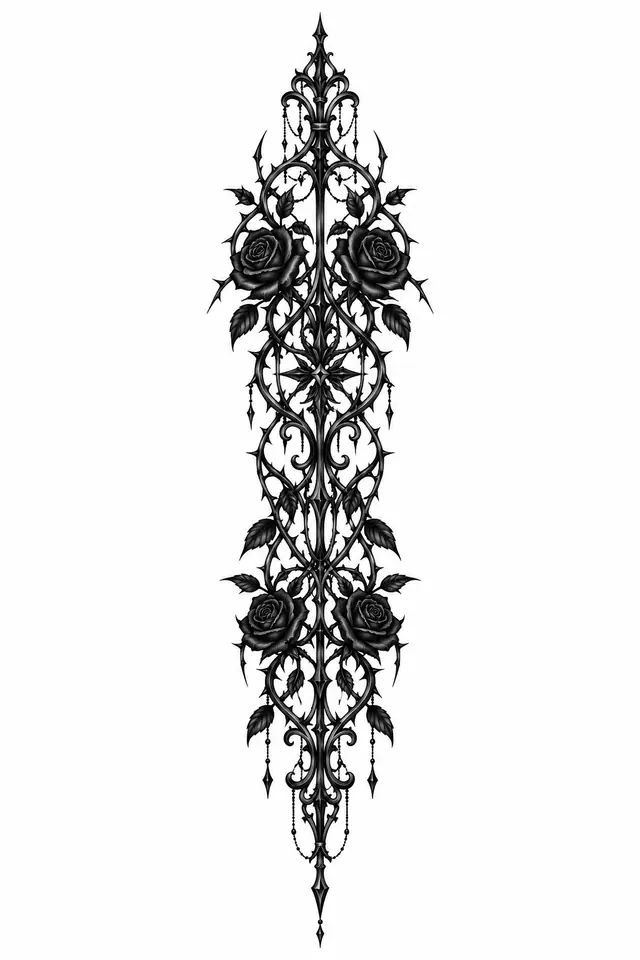
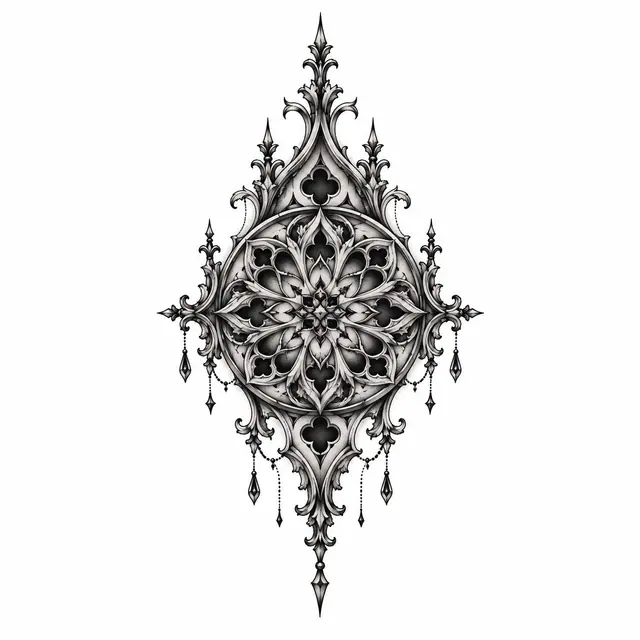
Our gallery includes an ornamental Victorian lace garter band, a symmetrical lace and filigree centerpiece, a gothic chandelier with crystal drops, a lace choker with a hanging cameo pendant, an ornamental jewel with chains and filigree drops, a lace mandala built from pointed gothic arches, and a lace ribbon bow with draped beads. Lace also appears as a modifier across the site, on a skull veiled in lace or a bat with lace-patterned wings.
Where it comes from
Handmade lace developed in Europe in the 16th century. Needle lace, worked with a needle and thread, grew up around Venice, while bobbin lace, made by twisting many threads on wooden bobbins over a pillow, became a specialty of Flanders. Both took enormous time, and fine lace was a luxury for centuries.
The 19th century changed that. Lace machines in England, with Nottingham as the center of the trade, made lace affordable for the Victorian middle class, and it spread onto collars, cuffs, curtains and parlor tables. Black silk lace from Chantilly in France became fashionable for shawls and veils. In the strict mourning customs that followed Prince Albert’s death in 1861, the first stage of mourning favored dull crape, while black lace and trims were more acceptable in the later, lighter stages. That link between black lace and grief is part of why it reads as gothic now.
Filigree is far older, used by goldsmiths since antiquity, and it was popular again in Victorian jewelry. Chandeliers fitted with cut-glass drops became a feature of grand rooms from the 17th and 18th centuries. Lace and chandelier tattoos as a style, though, are recent; they grew out of the ornamental and dotwork movement in tattooing over roughly the last couple of decades.
The lace mandala combines two traditions. The mandala form comes from Hindu and Buddhist sacred art; the version in our gallery swaps its usual petals for pointed gothic arches, a purely modern Western blend.
What it means today
Be wary of any site that gives lace a precise symbolic meaning. Historically it was decoration and a sign of wealth, not a code. Modern readings are personal:
- Elegance with a dark edge, the most common reason people choose black lace.
- Sensuality, especially for garter bands on the thigh.
- Heritage, copying a grandmother’s lace collar or a family wedding veil.
- Mourning, drawing on the Victorian link between black lace and grief.
That freedom is a strength. You can bring a real piece of family lace to your artist and have the pattern traced, which gives a lace tattoo more personal meaning than almost any symbol.
Popular designs and combinations
The garter band sits around the upper thigh with a scalloped lower edge, sometimes with a bow, a cameo or a small dagger tucked into it. See our thigh designs for how the band follows the leg.
The chandelier hangs from a central point, with arms curving out and crystals on chains below. It’s built for the sternum, where it can drop from the collarbones toward the ribs, and for the upper spine.
The lace choker with a cameo wraps the throat or sits just below it. It pairs naturally with Victorian tattoo designs, since cameos and lace were worn together.
The filigree jewel with chains works as a pendant on the sternum or a drop beneath a larger piece.
The lace mandala is circular, so it fits the shoulder cap, the elbow, the knee and the center of the back.
The ribbon bow with beads is a softer, smaller option, often placed on the back of the thigh or the side of the neck.
Styles that suit it
Dotwork is the most reliable way to tattoo lace. Stippled shading suggests mesh without asking the skin to hold dozens of tiny parallel lines. Our dotwork designs show how the texture holds.
Fine-line captures the delicacy of thread, and fresh fine-line lace looks spectacular. It is also the version most likely to soften within five to ten years, so make sure the design is big enough and keep the busiest mesh areas to a minimum.
Blackwork offers a clever reversal: pack the background solid black and leave the lace pattern as bare skin. It ages very well and suits people who want a bolder, heavier band.
Black and grey works for chandelier crystals, which need bright highlights against soft shadow to look like glass.
Etching is less common for lace, but it suits filigree jewels rendered like an engraved plate from a Victorian jewelry catalog.
Placement and size
Lace lives or dies by the size of its holes. Each opening in the pattern should be at least 2 to 3 millimeters across at the time of tattooing; smaller holes slowly fill in as ink settles. In practice that means:
| Design | Practical minimum | Good placements |
|---|---|---|
| Lace band (arm or ankle) | about 1.5 inches deep | forearm, upper arm, ankle |
| Garter | 2.5 to 4 inches deep | upper thigh |
| Choker | about 1.5 inches deep, plus pendant | throat, base of neck |
| Chandelier | 5 to 8 inches tall | sternum, upper spine, between shoulder blades |
| Lace mandala | 4 inches across | shoulder cap, elbow, knee, back |
Wraparound bands are hard to stencil, because limbs taper and the pattern must close neatly on the far side. Many artists draw the final band partly freehand with a skin marker. Throat and sternum are also among the more painful spots; our neck designs page and the gothic tattoo placement guide explain what to expect.
Things to watch out for
Symmetry is unforgiving. A chandelier or mandala that drifts a few millimeters off the center line of your body is obvious forever, so the stencil should be checked standing straight in a mirror, not lying down.
Repeating patterns also show every inconsistency. Ask your artist whether they will draw the repeat once and transfer it, or build it by eye, and look at their healed ornamental work before booking.
Using the prompts
The lace designs here are AI concepts, so an artist should redraw the pattern to fit your body before tattooing. Open any design to copy its ChatGPT prompt, then change the cameo to a moth or turn the chandelier into a choker.
Lace and filigree tattoo designs
Questions people ask
What does a lace tattoo mean?
Lace has no fixed traditional meaning as a tattoo. People commonly choose it for elegance and femininity with a dark edge, for sensuality in garter designs, or to honor a relative who made or wore lace.
Do lace tattoos age well?
They can, if the pattern is drawn large enough. Lace depends on small open holes, and holes smaller than about 2 to 3 millimeters tend to close up as ink spreads. Bold outlines around each motif and dotwork shading help the pattern survive.
Where should a lace garter tattoo go?
Usually around the upper thigh, either as a full band or as a front panel that fades out toward the inner thigh. It needs to be stenciled while you stand, because the thigh changes shape when you sit.
What is a chandelier tattoo?
A chandelier tattoo is an ornamental design that hangs like a light fixture, with arms, chains and crystal drops. It is a modern ornamental style, usually placed on the sternum, between the shoulder blades or down the spine.
How long does a lace tattoo take?
A palm-sized lace panel can often be finished in one sitting of a few hours. Full garters, sternum chandeliers and sleeve bands take longer and may need more than one session, depending on your artist's speed and how much shading is involved.
Related motifs
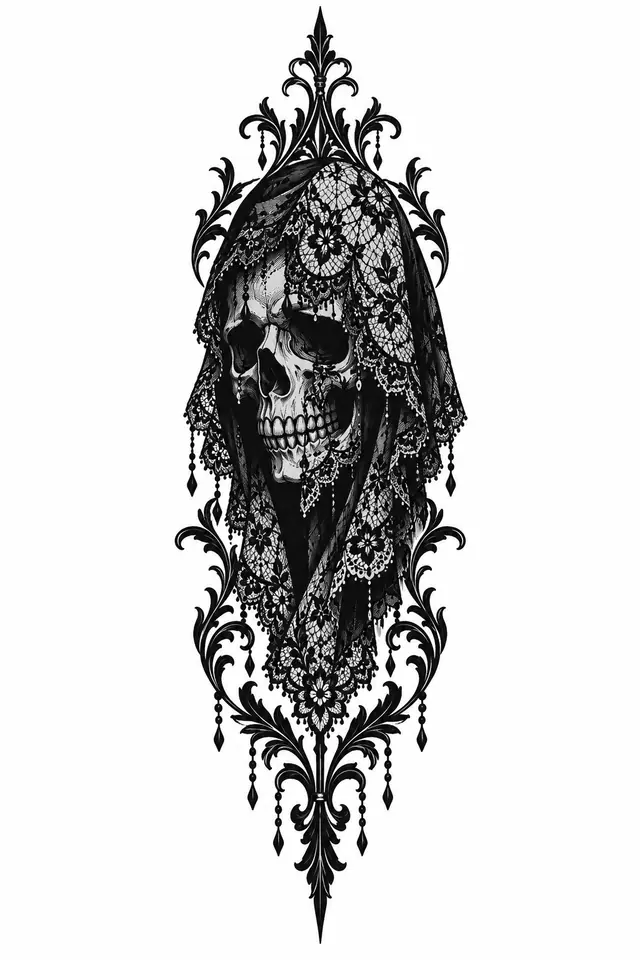 SkullMortality worn openly: the oldest reminder that life is short.
 Raven and crowPoe's messenger, read as omen, memory and intelligence.
 Black roseLove that outlives loss, grief and farewells.
 MothDrawn to the flame: transformation, night and the soul.
 BatCreature of the night, linked with rebirth and Dracula.
 Gothic crossFaith in stone and thorns, from churchyards to chains.
 CathedralPointed arches and rose windows from 12th-century France.
 GargoyleStone guardians that kept rain and evil off the roof.
 VampireRomance and hunger, from Victorian novels to now.