Gothic moth tattoos
A moth tattoo is the night side of the butterfly: drawn to light, short-lived and patterned in browns and greys. One species even carries a skull on its back, which made it a gothic favorite.
60 designs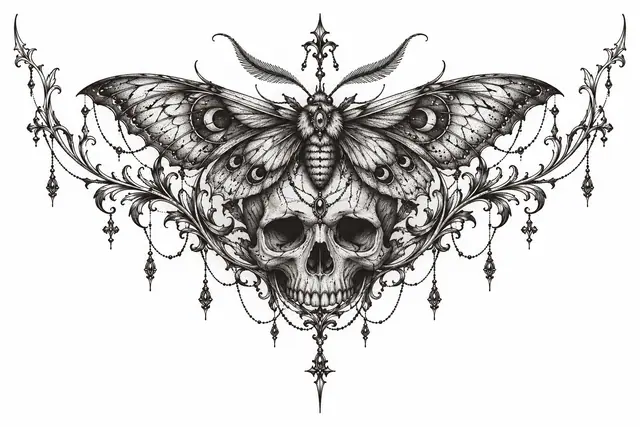
Why the moth became gothic
Butterflies belong to sunlight and gardens. Moths belong to the night, to porch lamps, attics and candlelit rooms. They are mostly muted in color, covered in soft scales, and drawn to light in a way that looks like devotion or doom depending on your mood. That makes the moth a natural gothic symbol, and the reason gothic moth tattoos have become as common as butterflies in dark tattoo portfolios.
The moth is also one of the best-shaped motifs in tattooing. Its body is a vertical axis, its wings spread evenly to each side, and the wing surface gives an artist a broad, flat area for pattern. Few subjects fit the sternum or throat so naturally.
The death’s-head hawkmoth
The moth that made the motif famous is the death’s-head hawkmoth, genus Acherontia. Three species exist. The one found in Europe and Africa is Acherontia atropos, named after the Acheron, a river of the Greek underworld, and Atropos, the one of the three Fates who cuts the thread of a life. The pale mark on its thorax looks remarkably like a human skull.
It is an unusual insect. It can squeak when disturbed, and it slips into beehives to drink honey. In parts of Europe it was long treated as a bad omen, and you can see why: a large moth with a skull on its back, making noises at night.
Its modern fame comes from The Silence of the Lambs. The 1991 film poster shows a death’s-head moth over Jodie Foster’s mouth, and if you look closely the skull on the moth is itself made from a Philippe Halsman photograph of women posed to form a skull, made with Salvador Dalí. Many death’s-head moth tattoos quote that poster.
For a tattoo, the skull marking is the whole point, and it is small on the real insect. Most artists enlarge it and simplify it so it still reads in ten years. If you want the skull to be recognizable, plan for a moth at least 3 inches across.
Other moths in gothic design
Luna moth. A North American moth with pale green wings and long trailing tails. Adult luna moths have no working mouthparts and live only about a week, which is why the luna moth is often chosen for brief, intense lives and for transformation. In black and grey the green is lost, so the long tails are what identify it.
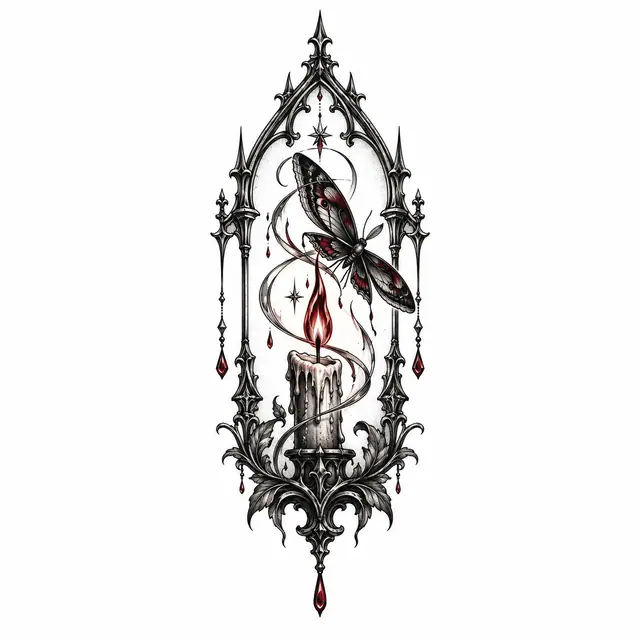
Moth and flame. “Thus hath the candle singed the moth,” says Portia in Shakespeare’s The Merchant of Venice. The idea that the moth flies into the flame that kills it is far older than modern science, which still debates why moths circle lights. As a tattoo it reads as obsession, devotion or knowingly chasing danger.
Moth as soul. The Greek word psyche meant both soul and butterfly, and in various European folk beliefs a moth at night was taken for a visiting soul. These beliefs varied a lot from place to place, so treat them as folklore, not as one fixed meaning.
What a moth tattoo means today
Today a moth is usually read as transformation, attraction to the light, the hidden self that comes out at night, or mortality when a skull is involved. It is also popular for memorial pieces, partly because of that folk idea of a moth as a visiting soul. And for plenty of people it is simply the gothic answer to a butterfly tattoo.
Gothic moth tattoo ideas from the gallery
- Death’s-head hawkmoth with the skull marking. The signature design. Works in every style.
- Luna moth with long tails. The tails add length, so it suits the spine or a tall forearm piece.
- Moth circling a candle flame. Tall composition; a red flame in an otherwise black design is a strong choice.
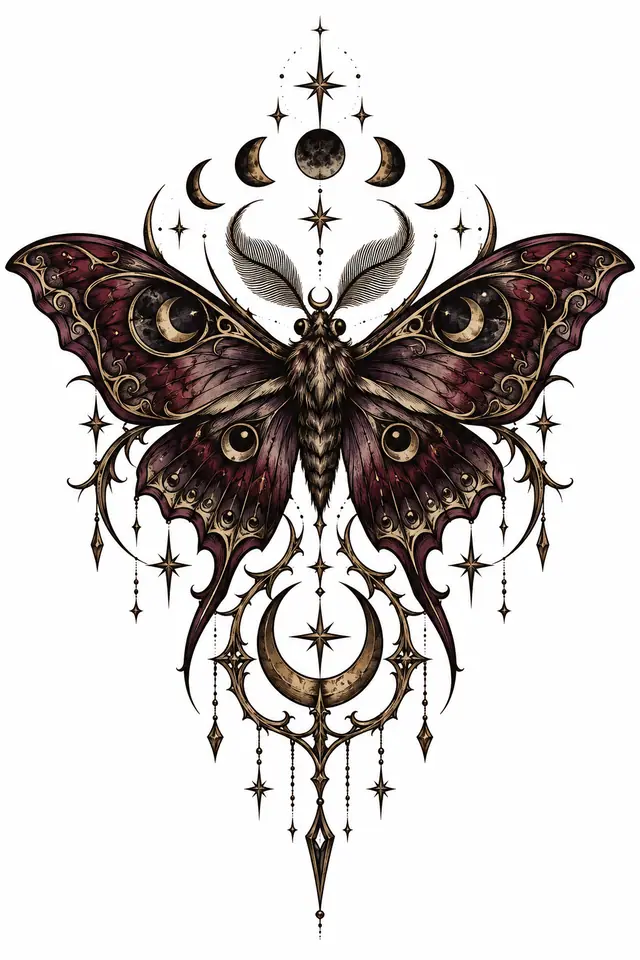
- Moth with a crescent moon between its wings. Night creature and night sky in one. The crescent moon page has more pairings.
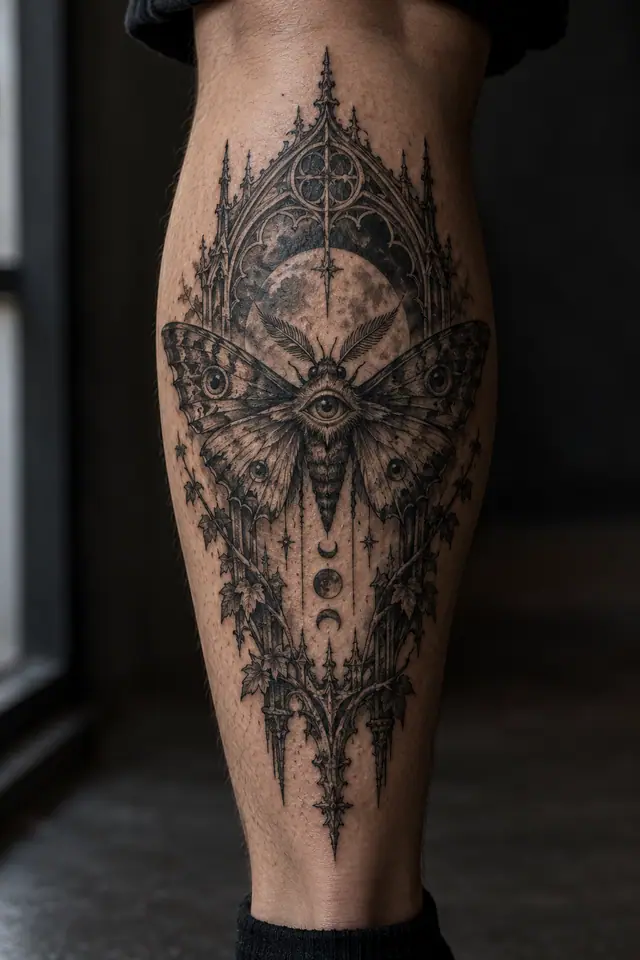
- Moth with an all-seeing eye on its body. Occult and graphic, very popular on the throat.
- Moth with stained-glass wings. Wing veins become the lead lines of a cathedral window. See cathedral for the architectural side.
- Symmetrical ornamental moth. Pure pattern: filigree, dots and geometric wing markings.
- Moth resting on a skull. The moth as the soul leaving the body. Our skull page covers sizing for the skull itself.
Styles that suit a moth
Dotwork is the moth’s natural style. Stippled shading looks like the powdery scales on real wings, and dotwork wing patterns hold up better over time than fine grey gradients. See our dotwork designs.
Fine-line moths are beautiful and very popular for small, simple gothic tattoos. Keep wing patterns open and the body solid. Browse our fine-line designs to see how much detail fits at each size.
Blackwork turns the moth into a bold, symmetrical emblem, close to a stamp or woodcut. Etching suits the death’s-head especially, recalling old natural history plates. Black and grey realism gives soft, furry bodies and is the best choice for a photographic death’s-head. Red accent belongs on the candle flame or the eye.
Placement and size
| Placement | Typical wingspan | Notes |
|---|---|---|
| Sternum | 4 to 7 in | The classic spot; the body sits on the breastbone |
| Throat | 3 to 4 in | Wings follow the width of the neck |
| Back of the hand | 2.5 to 3.5 in | Keep the wing pattern bold; hands fade fast |
| Between the shoulder blades | 4 to 6 in | Good for a larger, detailed moth |
| Forearm or knee | 2 to 4 in | Center it on the limb |
| Wrist or ankle | about 1 to 1.5 in | Outline and solid body only, no skull marking |
Sternum and throat tattoos hurt more than average and can need a touch-up, because the skin is thin over bone and moves a lot. Our sternum designs and placement guide have more on what to expect.
Symmetry is unforgiving on the center line. Ask your artist to place the stencil while you stand up straight and relaxed, then check it in a mirror from a distance. A wing that sits half a centimeter lower than the other will bother you forever.
Using the prompts
The moths in our gallery are AI concepts, each shown with its prompt. Copy one, swap “death’s-head hawkmoth” for “luna moth” or change the style, and generate variations until you find the composition you like. Then hand it to a tattoo artist to redraw, since AI moths often have six legs in the wrong place or wings that don’t match.
Moth tattoo designs
Questions people ask
What does a moth tattoo mean?
Popular readings include transformation, since moths change from caterpillar to winged adult, and attraction or devotion, from the way moths fly toward light. In gothic design, moths also stand for the soul, the night and mortality, especially the death's-head hawkmoth with its skull-like marking.
What is the moth with a skull on its back?
It is the death's-head hawkmoth, genus Acherontia. The pale pattern on its thorax looks like a human skull. Its scientific names refer to the river Acheron of the Greek underworld and to Atropos, the Fate who cuts the thread of life.
What is the difference between a moth and a butterfly tattoo?
Butterflies have thin antennae with clubbed tips and usually rest with wings folded upright. Moths often have feathery or tapered antennae, thicker furry bodies, and rest with wings spread flat. In a tattoo, feathery antennae and a fuller body are the easiest ways to make sure it reads as a moth.
What does a moth and candle tattoo mean?
It plays on the old image of a moth drawn to a flame that will destroy it. People use it for fatal attraction, obsession, devotion that costs something, or knowingly chasing what is bad for you.
Where does a moth tattoo look best?
Moths are symmetrical, so they suit center-line placements: sternum, throat, chest, the back of the neck, between the shoulder blades or the back of the hand. Smaller moths also work on the forearm or the knee.
Related motifs
 SkullMortality worn openly: the oldest reminder that life is short.
 Raven and crowPoe's messenger, read as omen, memory and intelligence.
 Black roseLove that outlives loss, grief and farewells.
 BatCreature of the night, linked with rebirth and Dracula.
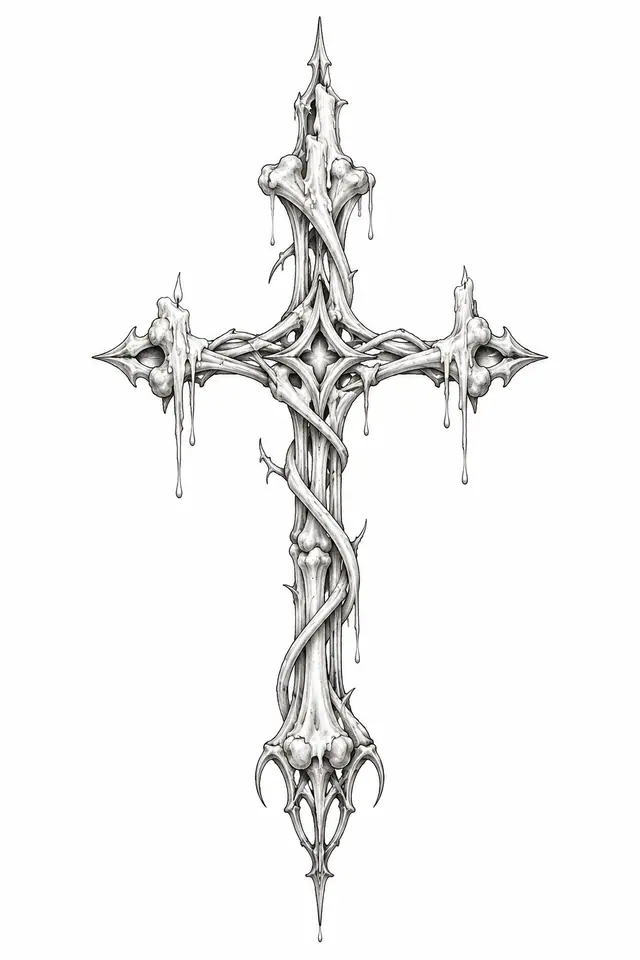 Gothic crossFaith in stone and thorns, from churchyards to chains.
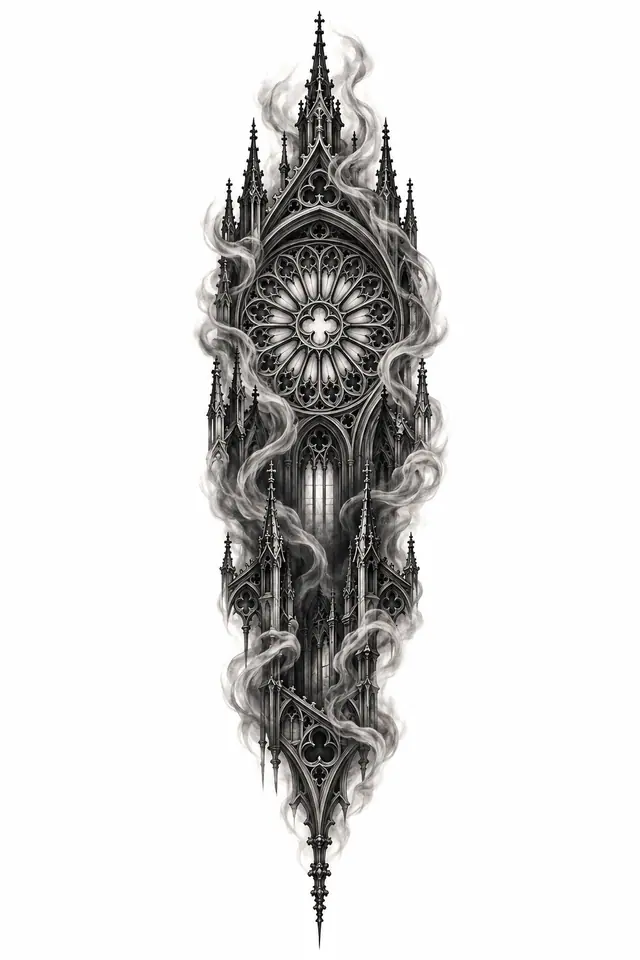 CathedralPointed arches and rose windows from 12th-century France.
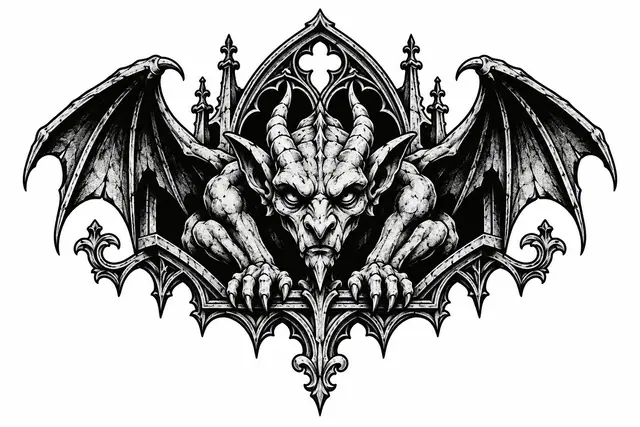 GargoyleStone guardians that kept rain and evil off the roof.
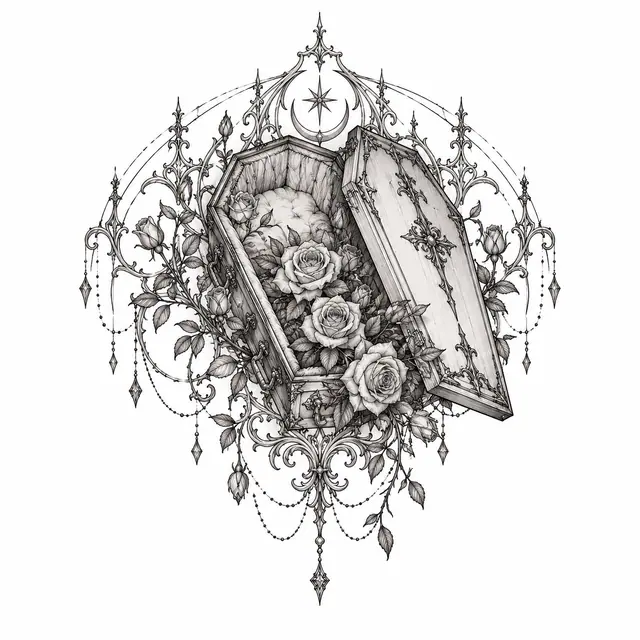 VampireRomance and hunger, from Victorian novels to now.
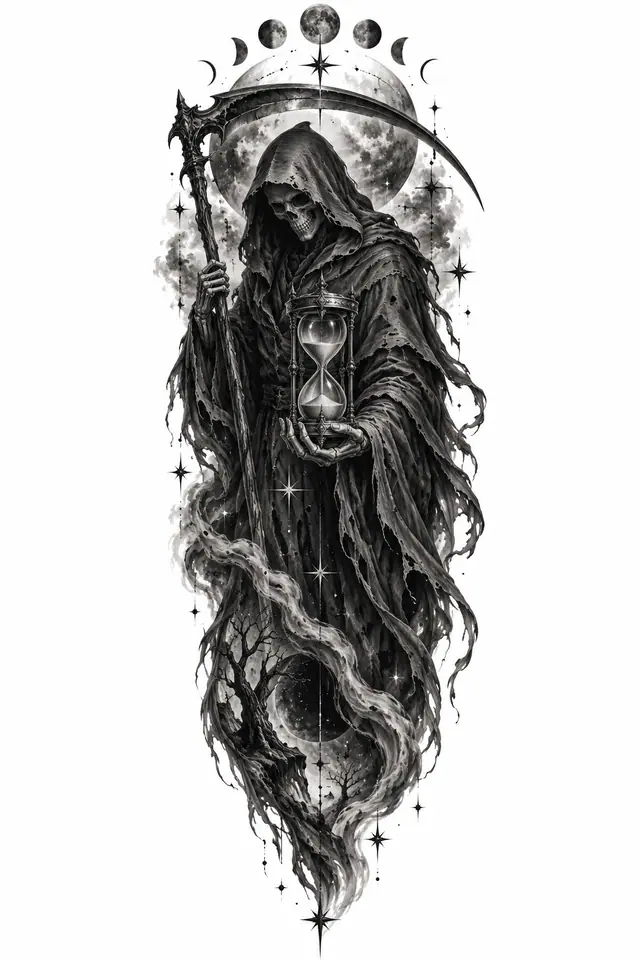 Grim reaperDeath personified, a reminder rather than a threat.